
A firm grip on the exotic
Processing of modern materials: A firm grip on the exotic
They are the exotics among the materials: Materials such as CFRP, titanium, honeycomb or aluminium are convincing due to their high strength combined with low weight and are preferably used in the aerospace industry. However, they place high demands on machining. HAM has been dealing with this topic for years and has developed a multitude of powerful standard and special tools. They score with long tool life and achieve very good surface finishes…
High-Performance Precision Tools from HAM for CFRP, Titanium, and More
While carbon fiber-reinforced plastic (CFRP) and titanium have been in use in the aerospace industry for quite some time, such modern materials are only gradually gaining acceptance in the automotive industry. These materials are certainly very popular among designers: they are lightweight yet strong and stable. Fiber-reinforced composites such as CFRP, for example, consist of a matrix material and reinforcing fibers. This combination makes the material highly durable. Aluminum is preferred in applications where weight is a critical factor, such as in aircraft. Its low density results in significant weight savings. The honeycomb structure consists of plastics or aramid fibers coated with various cover layers. This significantly increases stability. Titanium and its alloys are characterized by low density and high strength. These materials can withstand extreme thermal loads and are corrosion-resistant.
Machinists Face a Major Challenge
What they all have in common is that they pose major challenges for machinists. The specific properties of these materials make it very difficult to achieve reliable, high-speed machining with high surface quality. For example, CFRP is highly abrasive, which leads to significant tool wear. Especially with materials that have a high resin content, chipping frequently occurs during machining. The inhomogeneity of CFRP and other composite materials places considerable stress on the tool cutting edge. The material is machined into a powdery form. Excessive heat input can lead to undesirable fusion. For reliable machining, selecting the right tool, the appropriate geometry, and determining the suitable cutting parameters are crucial.
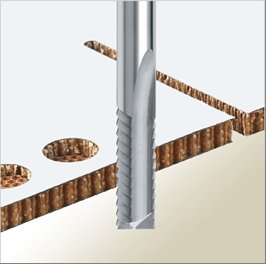
Honeycomb, which is lightweight yet resistant to bending, is often used between the inner and outer skins of aircraft or in the blades of wind turbines to provide support and rigidity. However, the material consists of a relatively loose composite, which means it can fray easily during machining. This requires extremely sharp cutting edges. The challenge in drilling and milling lies in ensuring not only contour- and dimension-accurate machining but also high-quality cut edges and surfaces.
Significant heat build-up at Titan
Machining titanium and its alloys generates a great deal of heat. This heat is absorbed not by the material itself, but by the cutting tool. Therefore, the correct geometry and coating must be selected to prevent premature tool failure. In addition, milling and drilling titanium often produces long chips that can wrap around the workpiece or tool and interrupt the process. Machining aluminum is comparatively the least problematic, as it can be performed at high cutting speeds. However, machinability depends on the alloy’s composition. Work-hardened or hardened aluminum is easier to machine than soft aluminum.
HAM has been intensively engaged in the machining of modern materials for years and has developed tools that master the challenges posed by these exotic materials. For example, HAM’s double-edged solid carbide special contour milling cutter delivers impressive results when producing grooves of various depths in honeycomb panels with a cover layer on both sides. At a cutting speed of 376 meters per minute and 20,000 revolutions per minute, it achieved a virtually burr-free surface. There was no fraying of the films. With a tool life of 450 meters achieved in long-term tests, the milling cutter has proven its process capability for series production.
HAM Countersink Drills for Top-Quality Finishes
A common application in CFRP is drilling and countersinking rivet holes in a single operation. The key challenge is to prevent burrs at the entry and exit points of the hole. To address this, HAM has developed a solid carbide (VHM) drill and countersink. With its special geometry and optimized diamond coating, it meets the requirements for component quality and tool life. The tool achieves dimensionally accurate bore diameters and countersinks. There is no fraying between the material layers, and the surface quality is excellent. The HAM 40-7640 PCD-HPC shank-on milling cutter, for example, enables high feed rates and cutting speeds when milling CFRP. In practice, this polycrystalline diamond tool delivers high material removal rates. Efficient cooling is provided centrally through the clamping screw.
With the One-Shot Drill, HAM has developed a high-performance tool that enables the drilling and reaming of sandwich components—as well as titanium—in a single operation. The diamond-coated tool facilitates the machining of titanium. In tests conducted at a cutting speed of 25 meters per minute, the drill achieved a precise diameter and high surface finish. Minimal-quantity lubrication prevents excessive heat buildup at the cutting zone of titanium components. In addition, the tool produces short chips that are easy to dispose of. The One-Shot Drill also delivers impressive results on sandwich components made of CFRP, titanium, and aluminum. It prevents fraying in the CFRP layer, and the drill exit is virtually burr-free.
The use of modern materials will continue to grow in the future. The design advantages offered by these exotic materials are simply too tempting to ignore. Manufacturers of precision tools will continue to face challenges. HAM will continue to work closely with its customers to address this issue in depth and develop suitable tools for the efficient and cost-effective machining of CFRP, titanium, and other materials.

 HAM GmbH
 HAM GmbH